 Driveway Cost Calculator
Introduction
A driveway is one of the most frequently used features of any home. Every day, it supports the weight of vehicles, endures changing weather conditions, and withstands years of exposure to sunlight, rain, snow, and temperature fluctuations. While every driveway eventually reaches the end of its useful life, its lifespan depends on much more than the material used during installation.
Homeowners often ask how long a driveway should last before it needs significant repairs or complete replacement. The answer varies depending on several factors, including the driveway material, installation quality, climate, traffic levels, and ongoing maintenance. A properly installed and well-maintained driveway can provide reliable service for decades, while poor construction or neglected maintenance may dramatically shorten its lifespan.
Understanding the expected lifespan of different driveway materials allows homeowners to plan future maintenance, budget for repairs, and make informed decisions when selecting a new driveway. It also helps identify early signs of deterioration before small problems become expensive structural failures.
In this guide, we'll explore how long different driveway materials typically last, what factors influence their durability, and the steps homeowners can take to maximize the life of their investment.
Average Lifespan by Driveway Material
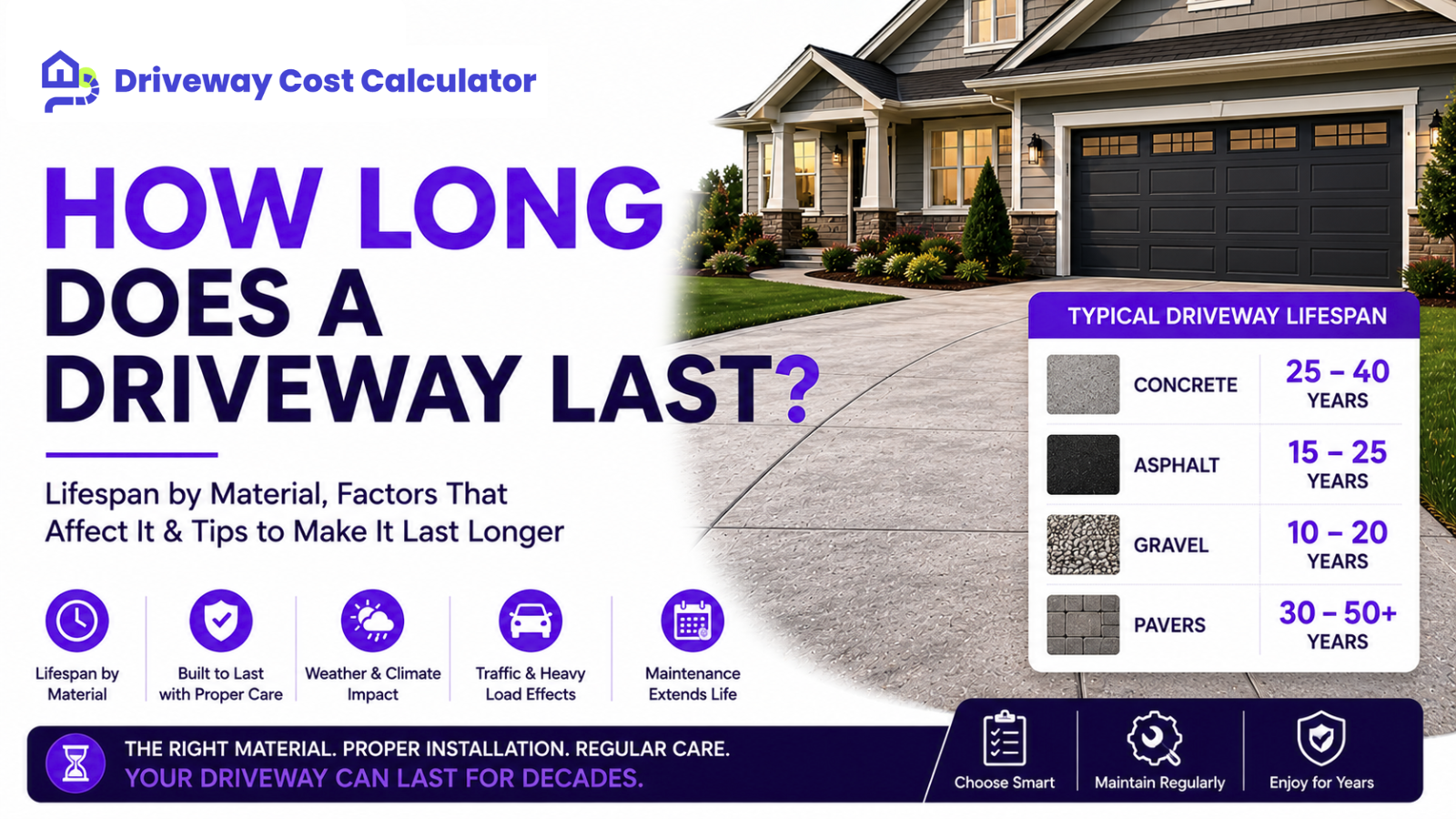
Different materials offer different balances between installation cost, maintenance requirements, appearance, and longevity. While every property is unique, the following estimates represent typical lifespans for professionally installed residential driveways.
| Driveway Material | Typical Lifespan |
|---|---|
| Concrete | 30–40 years |
| Asphalt | 20–30 years |
| Gravel | Indefinite with regular maintenance |
| Pavers | 30–50 years |
These figures assume proper installation, suitable drainage, and routine maintenance throughout the driveway's life.
Concrete Driveways
Concrete is widely regarded as one of the longest-lasting driveway materials available for residential properties.
When installed over a properly prepared base with adequate reinforcement and expansion joints, a concrete driveway can often remain in excellent condition for 30 to 40 years, with some installations lasting even longer.
Concrete's durability makes it highly resistant to heavy vehicle loads and everyday wear. It also requires relatively little routine maintenance compared to some alternative materials.
However, concrete is not maintenance-free. Small cracks should be repaired promptly, and homeowners should avoid allowing water to collect beneath the slab. Freeze-thaw cycles, poor drainage, and heavy de-icing salts may gradually accelerate deterioration in colder climates.
Regular cleaning and occasional sealing can help preserve the driveway's appearance while protecting the surface from moisture penetration and staining.
Asphalt Driveways
Asphalt remains one of the most popular driveway materials because it provides an excellent balance between affordability and performance.
A professionally installed asphalt driveway typically lasts 20 to 30 years, although climate, maintenance, and traffic levels all influence its actual lifespan.
Unlike concrete, asphalt is slightly flexible, allowing it to better accommodate ground movement and seasonal temperature changes. This flexibility makes it particularly popular in regions experiencing frequent freeze-thaw cycles.
To maximize longevity, asphalt should be sealed periodically to protect the surface from ultraviolet radiation, moisture, automotive fluids, and oxidation. Small cracks should also be repaired before water reaches the underlying base material.
When properly maintained, asphalt provides many years of reliable performance while remaining one of the most cost-effective paving options available.
Gravel Driveways
Unlike concrete or asphalt, gravel driveways do not have a fixed structural lifespan. Instead, their longevity depends almost entirely on ongoing maintenance.
With regular grading, replenishment of gravel, proper drainage, and weed control, a gravel driveway can remain functional indefinitely.
Because gravel surfaces naturally shift under vehicle traffic, periodic maintenance is expected rather than considered a repair. Adding fresh gravel every few years helps maintain a smooth driving surface while replacing material lost through erosion or displacement.
Although gravel generally requires more maintenance than paved alternatives, it remains an economical solution for rural properties, long driveways, and areas where lower installation costs are a priority.
Paver Driveways
Interlocking concrete or stone pavers offer one of the longest potential lifespans among residential driveway materials.
A professionally installed paver driveway can often last 30 to 50 years or more with appropriate maintenance.
One of the major advantages of pavers is that individual units can usually be removed and replaced without reconstructing the entire driveway. This simplifies repairs if localized settlement or damage occurs.
Regular joint sand replacement, occasional cleaning, and weed prevention help maintain both the appearance and structural performance of paver installations for many decades.
What Affects a Driveway's Lifespan?
While the material itself plays a major role in determining longevity, several other factors influence how long a driveway remains in good condition. Two driveways built from the same material can have dramatically different lifespans depending on how they are installed, used, and maintained.
Understanding these factors helps homeowners make better decisions before installation and extend the life of their investment after construction is complete.
Installation Quality
Perhaps the single most important factor affecting a driveway's lifespan is the quality of its installation.
Even premium materials cannot compensate for poor workmanship or inadequate preparation. A driveway built on an unstable base may begin developing cracks, settlement, or drainage issues within only a few years.
A professional driveway installation typically includes:
- Proper site excavation.
- A well-compacted base.
- Appropriate driveway thickness.
- Correct grading for effective drainage.
- High-quality construction materials.
- Adequate curing time before use.
Cutting corners during installation may reduce the initial project cost, but it often leads to significantly higher repair expenses later.
Climate and Weather Conditions
Weather is one of the few factors homeowners cannot control, yet it has a considerable impact on driveway durability.
In colder climates, repeated freeze-thaw cycles allow water to enter small cracks before expanding as it freezes. Over time, this process gradually enlarges cracks and weakens the driveway surface.
In warmer regions, prolonged exposure to ultraviolet radiation and extreme heat may cause asphalt to oxidize and become brittle, increasing the likelihood of cracking.
Heavy rainfall can also accelerate deterioration if drainage is poor, allowing water to weaken the base beneath the driveway.
Although weather affects every driveway differently, selecting materials that are appropriate for your local climate can greatly improve long-term performance.
Vehicle Weight and Traffic
The type and frequency of traffic also influence how long a driveway lasts.
A driveway used primarily by passenger cars experiences considerably less stress than one supporting heavy pickup trucks, delivery vehicles, recreational vehicles, or commercial equipment.
Repeated heavy loads may gradually compress the underlying base, especially if the driveway was not designed to support larger vehicles.
Homeowners expecting regular heavy traffic should discuss load requirements with their contractor before installation to ensure the driveway is constructed with sufficient thickness and structural support.
Drainage
Proper drainage protects both the driveway surface and the foundation beneath it.
Standing water may gradually penetrate small cracks, soften the supporting base, and accelerate deterioration. Over time, poor drainage often leads to settlement, potholes, edge failure, or surface cracking.
Professional driveway installations typically include a slight slope that directs water away from both the driveway and the home's foundation. Depending on the property, additional drainage solutions such as swales, trench drains, or drainage channels may also be recommended.
Maintaining clear drainage paths throughout the year helps prevent unnecessary water damage and extends the overall lifespan of the driveway.
Routine Maintenance
Regular maintenance is one of the simplest and most cost-effective ways to extend a driveway's lifespan.
Many homeowners mistakenly believe maintenance begins only after visible damage appears. In reality, addressing small issues early often prevents much larger repairs later.
Simple maintenance practices include:
- Cleaning leaves, dirt, and debris.
- Repairing small cracks promptly.
- Sealing asphalt when recommended.
- Removing weeds from joints and edges.
- Preventing standing water.
- Avoiding unnecessary heavy loads.
These relatively inexpensive tasks can add many years to the life of a driveway while preserving its appearance.
Signs Your Driveway Is Reaching the End of Its Life
Even with proper maintenance, every driveway eventually shows signs of aging.
Recognizing these warning signs helps homeowners decide whether repairs remain practical or whether replacement should be considered.
Common indicators include:
- Extensive cracking across large sections.
- Multiple potholes or surface failures.
- Uneven settlement.
- Persistent drainage problems.
- Loose or crumbling edges.
- Repeated repairs that no longer provide lasting results.
One isolated crack rarely indicates complete failure. However, widespread structural damage often suggests that replacing the driveway may be more economical than continuing temporary repairs.
Can Maintenance Really Add Years?
Absolutely.
Many driveways fail earlier than expected not because of poor materials, but because small maintenance issues were ignored for years.
For example, sealing asphalt every few years helps protect it from moisture and ultraviolet damage. Likewise, repairing minor concrete cracks prevents water from reaching the base beneath the slab.
Keeping drainage systems clear, cleaning the surface regularly, and addressing minor issues promptly all contribute to a longer service life.
Homeowners who invest a small amount of time in routine maintenance often postpone major repairs for many years, reducing the overall lifetime cost of ownership.
Repair or Replace?
Every driveway eventually reaches a point where homeowners must decide whether continued repairs remain worthwhile or if complete replacement is the better long-term solution.
The answer depends on both the extent of the damage and the overall condition of the driveway's foundation.
Minor issues such as small cracks, isolated potholes, faded surfaces, or localized settlement can often be repaired successfully without replacing the entire driveway. Prompt repairs help prevent water infiltration and slow the progression of larger structural problems.
However, replacement becomes the more practical option when damage is widespread. Multiple large cracks, significant settling, recurring drainage problems, or repeated repair work that fails to provide lasting results often indicate that the underlying structure has reached the end of its useful life.
Although replacement requires a greater initial investment, it frequently proves more economical than performing continual repairs on a deteriorating driveway.
How to Extend the Life of Your Driveway
Fortunately, homeowners can take several simple steps to maximize the lifespan of almost any driveway material.
Following these recommendations helps protect your investment while reducing future maintenance costs.
- Keep the surface clean. Remove leaves, dirt, oil stains, and debris regularly.
- Repair cracks early. Small cracks are easier and less expensive to repair before they grow larger.
- Maintain proper drainage. Ensure rainwater flows away from the driveway instead of pooling on the surface.
- Seal asphalt driveways periodically. Sealcoating protects against moisture, oxidation, and ultraviolet damage.
- Avoid unnecessary heavy loads. Large trucks, trailers, and construction equipment place significant stress on residential driveways.
- Inspect the driveway annually. Identifying minor problems early often prevents major repairs later.
Routine maintenance requires relatively little time but can add many years to the driveway's useful life.
Frequently Asked Questions
How long should a concrete driveway last?
A professionally installed concrete driveway typically lasts 30 to 40 years, although many remain functional even longer with proper maintenance and favorable conditions.
How often should asphalt be sealed?
Most asphalt driveways benefit from sealcoating approximately every three to five years, depending on climate, traffic, and the condition of the surface.
Can small cracks shorten a driveway's lifespan?
Not necessarily. Small cracks are common and can usually be repaired successfully. However, ignoring them allows moisture to reach the underlying base, which may eventually lead to more significant structural damage.
Does climate affect driveway longevity?
Yes. Freeze-thaw cycles, heavy rainfall, prolonged sunlight, and extreme temperatures all influence how quickly driveway materials deteriorate. Choosing the right material for your local climate can significantly improve long-term durability.
Is replacing a driveway always necessary when cracks appear?
No. Minor cracks are often repairable. Replacement is generally recommended only when structural damage becomes widespread or repeated repairs no longer provide lasting results.
Final Thoughts
A driveway represents a long-term investment in both the functionality and appearance of your home. While no driveway lasts forever, proper installation, quality materials, and regular maintenance can significantly extend its lifespan.
Understanding the expected longevity of different driveway materials helps homeowners plan future maintenance, budget for eventual replacement, and choose the most suitable material for their property and climate.
Perhaps most importantly, many of the factors that determine a driveway's lifespan are within the homeowner's control. Selecting an experienced contractor, ensuring proper drainage, repairing minor damage promptly, and performing routine maintenance all contribute to many additional years of reliable service.
Whether your driveway is newly installed or already several years old, taking a proactive approach to maintenance is often the most effective way to protect your investment and avoid unnecessary repair costs in the future.