 Driveway Cost Calculator
Introduction
One of the most important factors affecting the strength and longevity of a driveway is its thickness. Even the highest-quality materials can crack, settle, or deteriorate prematurely if the driveway is too thin for the vehicles using it.
Many homeowners focus on choosing the right material, but thickness plays an equally important role. A properly designed driveway distributes vehicle weight evenly, resists cracking, and provides decades of reliable service. On the other hand, reducing thickness to lower installation costs can lead to expensive repairs and a much shorter lifespan.
The ideal driveway thickness depends on several factors, including the material you choose, the type of vehicles that will use the driveway, local soil conditions, and the quality of the base beneath the surface.
In this guide, we'll explain recommended driveway thicknesses for the most common materials, discuss why thickness matters, and help you understand when thicker construction may be necessary.
Why Driveway Thickness Matters
A driveway must support thousands of pounds every time a vehicle enters or leaves your property. If the surface is too thin, excessive stress may eventually lead to structural damage.
Common problems caused by insufficient driveway thickness include:
- Cracking.
- Surface settlement.
- Rutting.
- Edge damage.
- Premature deterioration.
Proper thickness helps distribute vehicle loads across the underlying base, reducing stress on any single area. Combined with quality construction and good drainage, the correct thickness can significantly extend the life of your driveway.
Standard Concrete Driveway Thickness
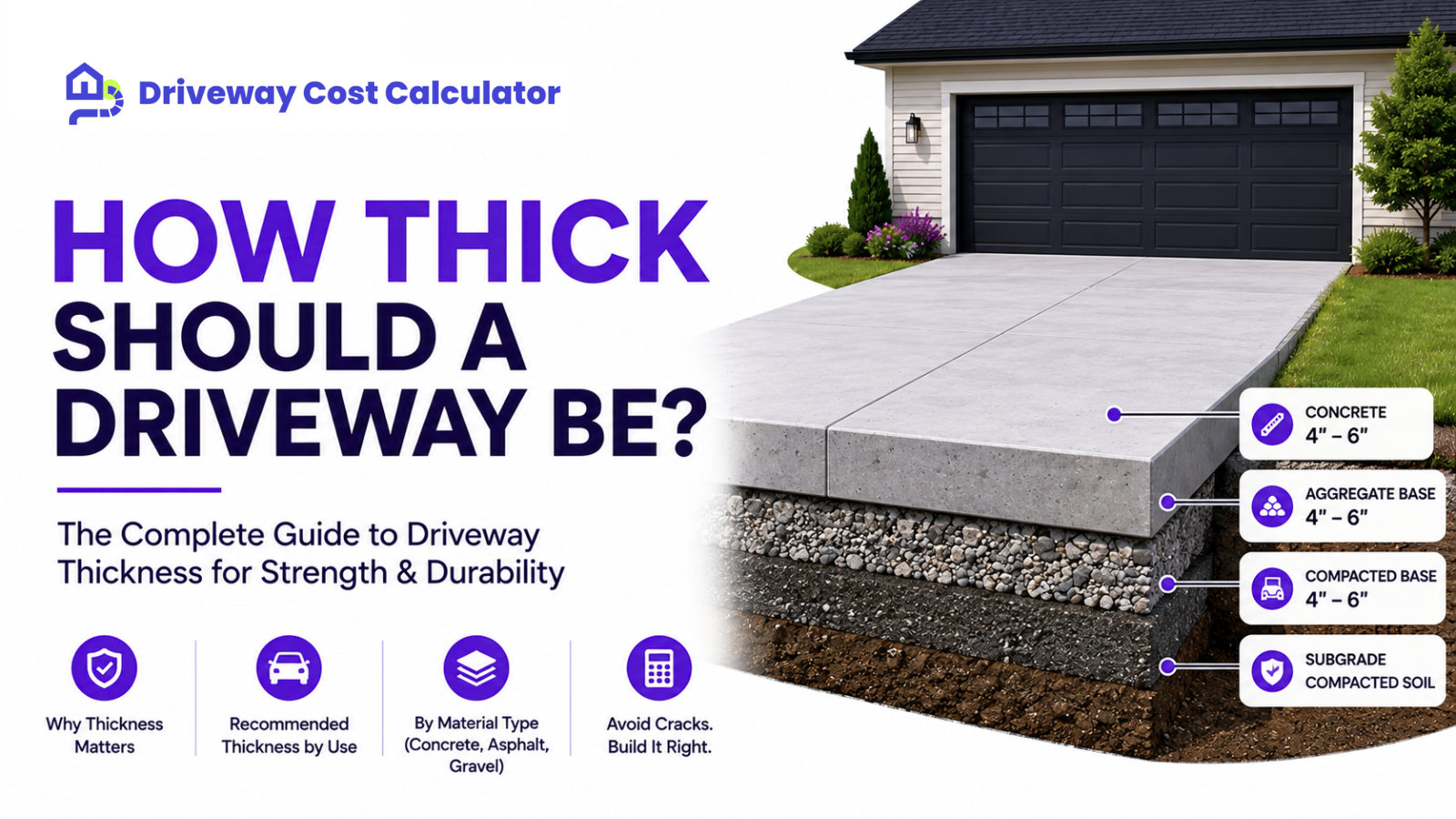
For most residential homes, 4 inches of concrete is widely considered the standard minimum thickness.
A properly reinforced four-inch concrete driveway can comfortably support:
- Passenger cars.
- SUVs.
- Pickup trucks.
- Small recreational vehicles.
Many municipalities also recognize four inches as the standard minimum thickness for residential concrete driveways.
When to Use 5 or 6 Inches of Concrete
Some driveways benefit from additional concrete thickness.
A five- or six-inch concrete slab may be recommended when:
- Large pickup trucks are common.
- Motorhomes or RVs will be parked.
- Delivery trucks frequently visit.
- Heavy trailers are regularly stored.
- The driveway receives unusually heavy traffic.
Increasing slab thickness improves load capacity and helps reduce the risk of cracking over the driveway's lifetime.
Standard Asphalt Driveway Thickness
Asphalt thickness is measured somewhat differently because asphalt driveways are built using multiple layers rather than a single slab.
For most residential properties, contractors commonly install approximately 2 to 3 inches of compacted asphalt over a properly prepared aggregate base.
The base beneath the asphalt is just as important as the surface itself. Without adequate base preparation, even a thick asphalt driveway may develop settlement or cracking over time.
When Is Thicker Asphalt Recommended?
Additional asphalt thickness may be appropriate when:
- Heavy trucks regularly use the driveway.
- Garbage trucks drive onto the property.
- RV parking is expected.
- Soil conditions are weak.
- The driveway serves multiple vehicles every day.
Depending on expected traffic and site conditions, a contractor may recommend either thicker asphalt, a stronger aggregate base, or both.
Gravel Driveway Thickness
Gravel driveways differ from paved driveways because they rely on several layers of aggregate rather than a solid surface.
A typical gravel driveway includes:
- A compacted foundation layer.
- A middle layer for structural support.
- A top layer of driving or decorative gravel.
The combined depth commonly ranges from 6 to 12 inches, depending on soil conditions, expected traffic, and local recommendations.
Long rural driveways or areas with soft soil may require even greater depth to maintain long-term stability.
Base Preparation Is Just as Important
Many homeowners focus only on the visible surface of the driveway, but the foundation beneath it is often what determines whether the project succeeds over the long term.
A properly prepared base should:
- Be thoroughly compacted.
- Provide effective drainage.
- Support expected vehicle loads.
- Minimize future settling.
Even a thick concrete or asphalt driveway can fail prematurely if it is installed over a poorly prepared base.
Soil Conditions Matter
Not all soil provides the same level of support for a driveway. The type and condition of the soil beneath your driveway can significantly influence the thickness and construction methods required for long-term performance.
Stable, well-drained soils generally require less preparation than soft, sandy, or expansive soils.
Clay soils deserve particular attention because they expand when wet and shrink during dry periods. This continuous movement can place additional stress on the driveway surface, increasing the risk of cracks or uneven settling if the base is not properly prepared.
Before construction begins, experienced contractors typically evaluate the existing soil conditions to determine whether additional excavation, stronger base materials, or increased driveway thickness may be necessary.
Reinforcement and Thickness
Concrete driveways often include reinforcement to improve durability and help control cracking.
Common reinforcement options include:
- Steel reinforcing bars (rebar).
- Welded wire mesh.
- Synthetic reinforcing fibers.
It's important to understand that reinforcement does not replace proper driveway thickness.
Instead, reinforcement helps control the size and location of cracks, while the concrete thickness provides the structural strength needed to support vehicle loads over many years.
Can a Driveway Be Too Thick?
In theory, yes. However, for most residential projects, installing a driveway that is significantly thicker than necessary simply increases construction costs without providing meaningful additional benefits.
Most homeowners gain little advantage from installing a residential driveway far beyond the recommended thickness unless heavy commercial vehicles or specialized equipment will regularly use the surface.
The goal is not to build the thickest driveway possible, but rather to choose a thickness that matches your expected traffic, soil conditions, and local building standards.
Recommended Thickness by Vehicle Type
| Vehicle Type | Recommended Driveway Thickness |
|---|---|
| Passenger Cars | Standard Residential Thickness |
| SUVs | Standard Residential Thickness |
| Pickup Trucks | Standard or Slightly Thicker |
| RVs & Motorhomes | Increased Thickness Recommended |
| Delivery Trucks | Increased Thickness Recommended |
| Heavy Commercial Vehicles | Engineer-Designed Pavement Recommended |
Common Mistakes
Homeowners sometimes make costly decisions when trying to reduce installation costs. Unfortunately, saving money during construction can result in much larger repair expenses later.
Some of the most common mistakes include:
- Choosing the thinnest possible driveway.
- Ignoring existing soil conditions.
- Reducing the thickness of the aggregate base.
- Hiring inexperienced contractors.
- Skipping proper base compaction.
Investing in proper construction from the beginning usually provides the best long-term value.
Questions to Ask Your Contractor
Before construction begins, ask your contractor several important questions about the proposed driveway design.
- How thick will the finished driveway be?
- How thick will the aggregate base be?
- Will reinforcement be installed?
- Is additional thickness recommended for my property?
- How were the soil conditions evaluated?
- Will heavy vehicles require changes to the design?
A qualified contractor should be able to clearly explain why a particular driveway thickness is appropriate for your specific project.
Frequently Asked Questions
Is a 4-inch concrete driveway thick enough?
For most residential homes, yes. A properly installed four-inch concrete driveway is widely considered the standard minimum thickness and can comfortably support passenger vehicles, SUVs, and most pickup trucks.
Should I install a thicker driveway for an RV?
Yes. RVs, motorhomes, and other heavy vehicles place much greater stress on a driveway, and contractors often recommend increasing the slab thickness or strengthening the base accordingly.
Is the base more important than the surface?
Both are equally important. Even a thick driveway can fail prematurely if the underlying base is not properly prepared, compacted, and drained.
Can reinforcement replace additional thickness?
No. Reinforcement helps control cracking but does not replace the structural strength provided by adequate driveway thickness.
Does thicker always mean better?
Not necessarily. The ideal driveway thickness depends on the expected vehicle loads, local soil conditions, drainage, and applicable building standards. Installing more material than necessary usually increases costs without providing significant additional benefits.
Final Thoughts
Choosing the correct driveway thickness is one of the most important decisions you'll make during your project. While standard residential driveways often perform well with typical construction depths, heavier vehicles, weaker soils, and challenging site conditions may require thicker pavement or additional base preparation.
Rather than focusing solely on the visible surface, homeowners should also pay close attention to base construction, drainage, soil conditions, and reinforcement. Together, these elements determine how well a driveway performs over the coming decades.
Before requesting contractor estimates, consider using a Driveway Cost Calculator to estimate your project budget based on your driveway size, preferred material, and location. Understanding the expected costs ahead of time makes it easier to compare proposals and ensure you're investing in a driveway that's built to last.